

It has been a busy start to 2026 for LEL, with progress on federal advocacy priorities, new publications from our team, and critical work to advance safety and justice by members across the country.
In February, we produced a new video featuring members of the network discussing the importance of LEL’s mission and values. Huge thanks to all who participated – Seattle (WA) Police Chief Shon Barnes, Former Assistant U.S. Attorney Kami Chavis, Ramsey County (MN) Attorney John Choi, Denver (CO) Sheriff Elias Diggins, Middlesex County (MA) Sheriff Peter J. Koutoujian, Portsmouth (VA) Commonwealth’s Attorney Stephanie Morales, LEL Director Ruby Nidiry, Former Advisory Board Chair Ronal W. Serpas, and Former Secretary of Corrections (WA) Bernard Warner. The video can be found on the LEL homepage (along with other upgrades to the website).
In February, we also launched a new “member spotlight” series, highlighting innovative policies our members are leading, such as:
If you have any policies or programs you would like us to highlight that embody LEL’s mission – reducing recidivism, strengthening community relationships, and improving oversight and accountability to build a fairer and more effective justice system – let us know!
 As we announced last month, we are excited to welcome Colonel James W. Baker (Ret.) as the new Chair of LEL’s Advisory Board.
Jim has served more than 30 years with the Vermont State Police, including as Director from 2006 to 2009. Among other policing leadership roles, he later served as Chief of Police for the City of Rutland, VT, where he led community-policing efforts that reduced crime and launched Project VISION, a nationally recognized community collaboration initiative. He served as Interim Commissioner of the Vermont Department of Corrections in 2020. As the Director of Law Enforcement Operations and Support and Director of Advocacy at the International Association of Chiefs of Police, he worked on national and international criminal justice issues, including developing the Institute of Community Police Relations and creating the first ever national conference focused on officer safety and wellness.
Jim currently leads JW Leadership Consulting, providing public safety consulting, leadership coaching, executive searches, and agency operational assessments across New England. He received a B.S. in Criminal Justice Management from Southern Vermont College and is a graduate of the 188th Session of the FBI National Academy at Quantico, Virginia.
And, of course, a special and heartfelt thanks to Ron Serpas for his years of leadership that shaped LEL since its founding in 2015. We are grateful that Ron will continue to support LEL as a member of the Advisory Board.
“We Are Not Going to Arrest Our Way Out of This”: Law Enforcement’s Evolving Response to the Fentanyl Crisis with Case Studies from Corrections, Rosemary Nidiry and Jessica Brenner, University of St. Thomas Law Journal (February 2026).
This article, co-authored by LEL Director Rosemary Nidiry and former Policy Associate Jessie Brenner, arose from insights shared by LEL members at the University of St. Thomas Law Journal’s Symposium, Fentanyl – Tragedies and Solutions in October 2024. The article provides an overview of the ways law enforcement leaders are embracing public health responses to address addiction, with a special focus on corrections. We are grateful to LEL’s Mark Osler, Professor of Law at the University of St. Thomas School of Law, and the editors of the University of St. Thomas Law Journal for organizing the symposium, and to members Sheriff Kalvin Barrett of Dane County (WI), Sheriff Dawanna Witt of Hennepin County (MN), and Minnesota Commissioner of Corrections Paul Schnell, who shared their innovations at the Symposium and are featured in the article.
Prison Reform in the United States: Efforts to Improve Conditions and Post-Release Outcomes, Brennan Center for Justice (various authors) (March 2026).
This report examines innovative approaches to improving prison conditions and post-release outcomes across a range of states, drawing on site visits, interviews, and original survey research. It features reforms in Maine, Michigan, North Dakota, Pennsylvania, and elsewhere, and identifies strategies for sustaining and replicating them. LEL is proud to have several members featured, including Director Colby Braun of the North Dakota Department of Corrections and Rehabilitation on reducing solitary confinement; Commissioner Randall Liberty of the Maine Department of Corrections on the “Maine Model of Corrections”; Sheriff Peter Koutoujian of Middlesex County (MA), whose office is a young adult rehabilitation site listed by Restoring Promise, one of the featured programs; Dr. Nneka Jones Tapia, Managing Director of Justice Initiatives at Chicago Beyond, on family visitation reform at Cook County Jail; Director Heidi Washington of the Michigan Department of Corrections on the Vocational Villages skilled trades training program; and Former Secretary of Corrections (PA) John Wetzel on reform efforts at State Correctional Institution Chester (SCI Chester). In addition, Former Executive Director of the Colorado Department of Corrections Rick Raemisch and Former Secretary of Corrections Bernard Warner shared their expertise and helped coordinate member participation in the research.
Congressional staff briefing, Funding Cuts to Health and Their Impact on Public Safety: Law Enforcement & Public Health Leaders’ Perspectives (January 14, 2026)
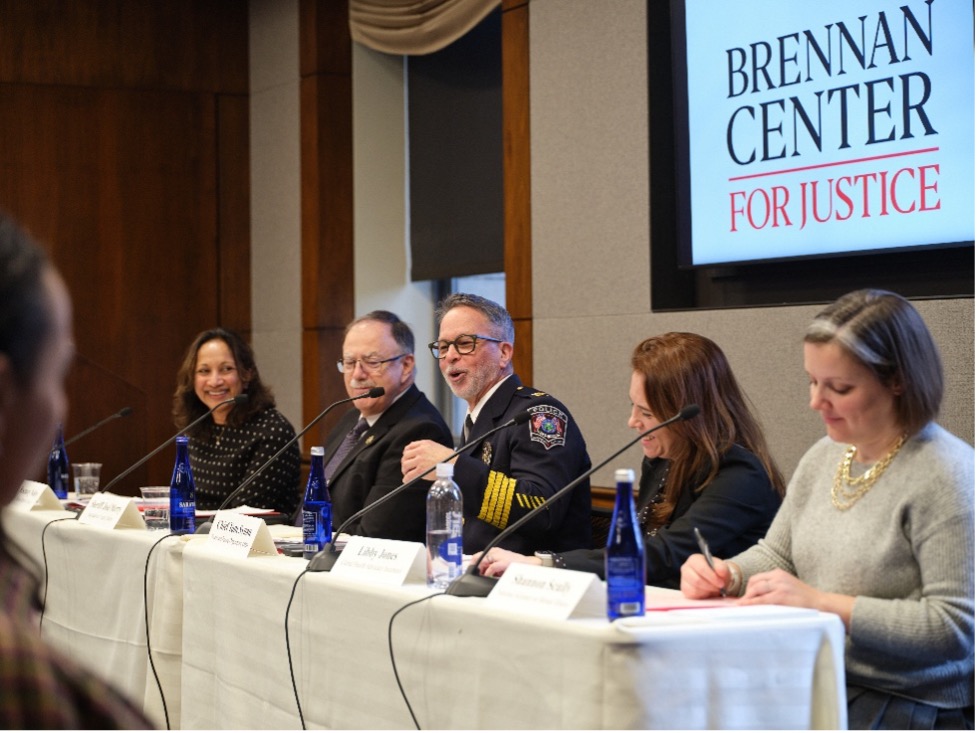
In January, LEL Director Rosemary Nidiry moderated a bipartisan Congressional staff briefing organized by the Brennan Center’s Justice Program and sponsored by Rep. Jamie Raskin (D-MD), with remarks by Rep. John Rutherford (R-FL). The briefing brought together local law enforcement leaders and behavioral health experts to discuss the importance of federal investments in public health and how early intervention and high-quality care can reduce justice system involvement, including why continued federal support for drug treatment and crisis response is critical for public safety. LEL’s Sheriff Joel Merry of Sagadahoc County, Maine participated as a panelist alongside behavioral health and public health leaders including Shannon Scully, Director of Justice Policy & Initiatives at the National Alliance on Mental Illness; Libby Jones, Associate Vice President of the Overdose Prevention Initiative at the Global Health Advocacy Incubator; and Newtown (OH) Police Chief Tom Synan.
As we first announced in our September 2025 newsletter, we are launching a new working group initiative that will bring a small number of LEL members together to share expertise on relevant and timely justice policy issues. The first topic we are exploring is a potential working group and white paper on rebuilding – and improving – federal grantmaking. Stay tuned for news on this exciting project.
This quarter, LEL continued to advocate for evidence-based reforms that enhance public safety, support successful reentry, and promote oversight and accountability in the justice system.
Many programs we supported (noted in our 2025 Year in Review) continue to advance with the passage of appropriations bills in January and February 2026. Here are key components:
Additionally, in March, LEL joined a letter urging the FY2027 Commerce, Justice, Science and Related Agencies Appropriations Subcommittees to restore funding for the Byrne Justice Assistance Grant (Byrne JAG) program on pace to return to its FY2010 level of $520 million, alongside additional funding for the Law Enforcement De-Escalation Training Act. The letter was signed by a broad coalition of national organizations spanning law enforcement, corrections, prosecution, behavioral health, and victim advocacy.
LEL members continue to advance practical approaches that strengthen public safety, improve accountability, and support a fairer justice system. Here are some highlights from around the network:
Improving Law Enforcement & Public Safety Practices
Advancing Justice & Accountability
Strengthening Reentry & Rehabilitation
Recognizing Leaders & Community Impact
Workforce Trends in State Departments of Corrections: A 50-State Analysis, Safe Inside (February 2026) — A 50-state analysis, mentioned above, that examines the national corrections staffing crisis and how that is impacting the safety of both incarcerated individuals and staff.
Advancing Women’s Justice: What We Should Know, But Don’t, Council on Criminal Justice (February 2026) — A research agenda identifying critical gaps in data and evidence on women at the front end of the justice system, with actionable recommendations for researchers, funders, and system leaders across policing, pretrial, and sentencing.
State Strategies to Leverage Existing Medicaid Reentry Practices to Support Implementation of the One Big Beautiful Bill Act, Health and Reentry Project (January 2026) — Identifies four strategies states can use to build on existing Medicaid reentry work to implement new community engagement requirements and eligibility renewal periods from recent legislative changes to Medicaid.
(Re)Imagining Justice for Youth Impact Report: Increased Access, Reduced Recidivism Assessing three years of shared power and increased community accountability, Kara Beckman, MA, & Rebecca Freese, MS, University of Minnesota (January 2026) — University of Minnesota evaluation, mentioned above, that finds that youth whose cases were resolved through Ramsey County’s collaborative, restorative community accountability process had significantly lower recidivism rates than those processed through traditional court, with reduced racial disparities in outcomes.
Life Sentences in the United States: Exploring the Data, Wilson Center for Science and Justice, Duke Law (December 2025) — An interactive dashboard presenting two decades of data on people serving life sentences across all 50 states and the federal system, drawn from national census data between 2003 and 2024.
Follow us on our LinkedIn page!

