In the second quarter of 2026, LEL highlighted practical reforms led by members across the country along with core issues such as supporting successful reentry, investing in innovations that advance health and safety, and improving prison conditions.
We published a new entry in our “Member Spotlight” series, Guiding Older Adults Toward Reentry, from the Inside Out, in April. The piece profiles the Older Adult Re-Entry Unit pioneered by Middlesex County (MA) Sheriff Peter J. Koutoujian. The unit, launched in October 2024, prepares older adults in custody for life back in the community through programming focused on cognitive behavioral treatment, social enrichment, education, occupational therapy, and healthy living, addressing unique needs that are often overlooked in correctional settings.
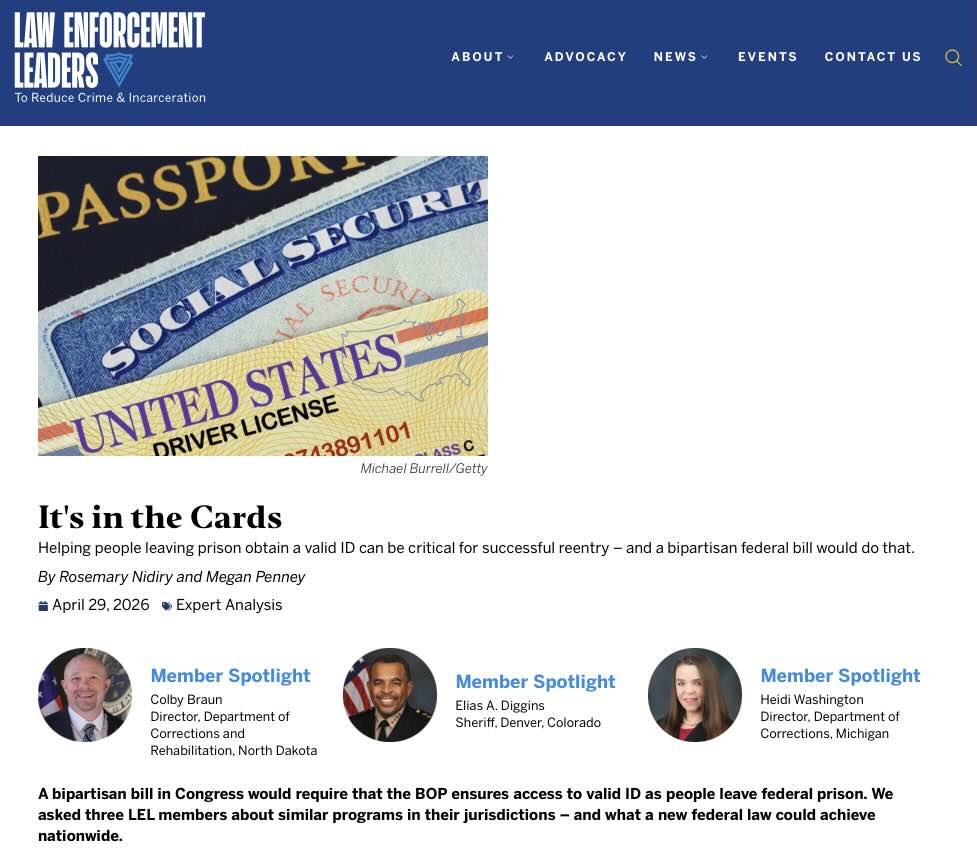
We also published It’s in the Cards, an Expert Analysis on the BOP Release Card ID Act, a bill currently pending in Congress with bipartisan support that LEL has championed. The bill would help people leaving federal custody obtain valid identification. In this Q&A, North Dakota Department of Corrections and Rehabilitation Director Colby Braun, Denver (CO) Sheriff Elias A. Diggins, and Michigan Department of Corrections Director Heidi Washington discussed why they have each initiated similar programs in their jurisdictions. They shared why identification, which provides access to employment, housing, banking, health care, treatment, federal benefits, and other supports after release, is important for public safety, and why the federal government should follow their lead.
Members also participated in a broader national conversation on improving prison conditions. In June, the Brennan Center and Vera Institute of Justice co-hosted a symposium on prison reform, bringing together correctional leaders, currently and formerly incarcerated people, researchers, funders, and legal experts to discuss how to sustain and build on successful innovations to improve prisons and jails. North Dakota Department of Corrections and Rehabilitation Director Braun and Maine Department of Corrections Commissioner Randall Liberty spoke at the symposium. LEL Advisory Board Chair James Baker and Director Rosemary Nidiry also participated.
If you are interested in learning more about these or other initiatives, please don’t hesitate to reach out!
EVENTS
LEL Working Group Meeting on Federal Grantmaking Reform (April 14, 2026)
In April, LEL convened a virtual meeting as part of our Working Group initiative to rebuild and improve federal grantmaking to better respond to local needs and more effectively promote innovations that advance safety and justice (described in our September 2025 newsletter). Around a dozen LEL members from across policing, prosecution, and corrections backgrounds joined the discussion, offering feedback that will help shape the Working Group’s recommendations. Thank you to all who participated, and keep an eye out for a white paper in the coming months.
ADVOCACY
This quarter, we continued to advocate for evidence-based reforms to enhance public safety by promoting successful reentry, improving oversight and accountability, and expanding access to treatment for mental health and substance use disorders.
In April, Second Chance Month, we endorsed the following bills supporting reentry:
- The One Stop Shop Community Reentry Program Act would provide $10 million annually for the Department of Justice (DOJ) to support grants for community-based nonprofits to create one-stop reentry centers that assist formerly incarcerated individuals in their transition home. It would also provide $1.5 million annually for DOJ-funded reentry hotlines operated by states, tribes, and local governments, and outlines mentorship programs connecting individuals with formerly incarcerated mentors.
- The National Reentry Week Resolution would designate the final week of April (April 24 to 30) as “National Reentry Week,” promoting the use of resources to reduce recidivism and support the roughly 600,000 Americans who reenter society after incarceration each year through educational, employment, behavioral health, and credit support.
In May, LEL joined a letter urging Congress to maintain robust funding for overdose prevention, substance use disorder (SUD) treatment, and recovery support services. Following significant FY2026 bipartisan action, a proposed consolidation of multiple behavioral health programs and reduction in funding would limit states’ capacity to sustain evidence-based treatment and put more individuals at risk. The letter was signed by a broad coalition of national, state, and local organizations spanning law enforcement, behavioral health, medicine, recovery, and substance use disorder advocacy.
In June, LEL Director Rosemary Nidiry and Brennan Center Senior Policy Strategist JC Hendrickson met with Congressional staff in eight House offices to urge support for the BOP Release Card ID Act. Building on the April Q&A noted above, they met with both Democratic and Republican offices across the Michigan and Colorado delegations, highlighting the leadership of LEL members in those states and urging support for the bill.

NEWS FROM AROUND THE NETWORK
In their own jurisdictions, LEL members are leading a wide array of innovative criminal justice strategies to enhance public safety and foster stronger community relationships. Here are some highlights:
Improving Law Enforcement Practices
- Building on Ramsey County’s (MN) successful nonfatal shooting unit, which has dramatically improved the investigation and clearance rates of non-fatal shootings, County Attorney John Choi urged state lawmakers to pass a bill providing $1 million in grants to help other jurisdictions in the state adopt the model. The Ramsey County effort was especially evident in St. Paul, where the solve rate for nonfatal shootings rose from 37% in 2024 to 71% in 2025, and nonfatal shootings dropped 62%, from 183 to 73.
- Albany (NY) established a new Office of Violence Prevention to coordinate work among city departments, community organizations, violence-interruption groups, and public safety partners. Police Chief Brendan Cox described the office as an example of what collaboration can accomplish and how the department is prioritizing working with partners to address the root causes of violence.
- At a recent conference on law enforcement and security challenges, Fairfax County (VA) Police Chief Kevin Davis discussed the various artificial intelligence tools the department uses, such as real-time translation, voice-enabled policy guidance, and speech-to-text report generation. He explained that the technology is helping officers communicate more effectively at the scene and produce more complete and accurate reports.
- In a recent interview with a local television station, Police Chief Axel Henry of St. Paul (MN) discussed a number of issues, including the department’s revised approach to traffic stops, which has shifted focus from lower-level equipment violations in order to prioritize traffic safety. Since the new policy was implemented, gun recovery numbers have risen and there has been no negative impact on public safety.
- Forsyth County (NC) Sheriff Bobby Kimbrough is partnering with Winston-Salem State University to create a new Senior Leadership Program. The program, which is designed to prepare young people for future leadership opportunities, teaches leadership skills and connects graduating students with elected officials, judges, business professionals, and other community leaders.
- A newly released Prince William County (VA) crime report showed that overall crime declined by 9% in 2025 and violent crime fell by more than 17%. Police Chief Peter Newsham also highlighted a 100% homicide clearance rate and praised the department’s criminal investigations division for its work.
Promoting Alternative Responses
- Seattle (WA) Police Chief Shon Barnes introduced a new “neighborhood-oriented policing” strategy to promote a more localized approach to policing through the Neighborhood Resource Officer initiative in one neighborhood, Magnuson Park. The effort has drawn interest from other areas in Seattle, with plans to expand as staffing allows. Chief Barnes said, about the initiative, “This is what our commitment to public safety is about …. establishing relationships with our community and making sure that we can serve our community in the way that they want to be served.”
- Contra Costa County (CA) District Attorney Diana Becton called on prosecutors to embrace a broader understanding of accountability that includes restorative justice as a tool used alongside other more traditional approaches. Speaking at a Berkeley Law conference in April, she noted that punishment alone doesn’t fully address victims’ needs, help communities recover, or prevent future harm.
- In Boston (MA), a summer safety plan outlined by Police Commissioner Michael Cox includes expanded teen-centered programming through the “Boston After Dark” initiative and focuses on preventing violence and retaliation, getting guns off the streets, and addressing neighborhood safety and quality-of-life concerns.
- District Attorney John Creuzot, of Dallas County (TX), pointed to a new report confirming that juvenile justice reforms his office launched in 2022 are paying off. The average time youth spend in detention before their case is resolved has dropped to about 57 days, down from 140 days four years ago, with detention numbers falling 24% as low-risk youth are diverted to alternatives instead of courtrooms.
- At the recent National Association of Prosecuting Attorneys’ Domestic Violence Prosecution Conference in Salt Lake County (UT), District Attorney Sim Gill urged prosecutors to move beyond a “wins-and-losses” view of domestic violence cases. He said an early case taught him that securing a conviction may not address the circumstances keeping a survivor in an abusive relationship, shaping his push for prosecutors to work with community partners and consider victims’ broader needs.
- In Brooklyn (NY), District Attorney Eric Gonzalez has credited faith leaders and other partners for helping his office implement successful changes to mental health and substance-use prosecutions that seek to address underlying issues like poverty and trauma. He pointed to the Brooklyn Mental Health Court’s continued success: participants are 50% less likely to be re-arrested, with 70 to 90% of its 1,200-plus participants avoiding incarceration.
- Keeping young people engaged during the summer is a central part of the Richland County (SC) Sheriff’s Department’s violence-prevention strategy. Sheriff Leon Lott highlighted a range of structured youth programs, including several new offerings aimed at reducing crime by providing positive activities while school is out.
- The Together We Rise Crisis Intervention Team (CIT) Resilience Summit, hosted by Illinois Law Enforcement Training and Standards Board Chairman Sean Smoot, addressed the demands placed on crisis intervention professionals and the meaning of public safety.
Supporting Successful Reentry
- LEL Advisory Board Chair James W. Baker spoke about the value of creative programming in correctional facilities while discussing the Finding Hope Within exhibit. Featuring artwork, poetry, and letterpress prints created by incarcerated Vermonters through prison-based programs and collaborations, the exhibit reflects the kinds of opportunities Baker said can help incarcerated people recognize skills and strengths they may not realize they have.
- Maine’s Department of Corrections Commissioner Randall Liberty recently announced that the department has joined Reentry 2030, a national initiative aimed at breaking cycles of incarceration. Through the initiative, Maine has committed to reducing its return-to-custody rate by 30% while expanding supports such as housing, treatment, education, vocational programs, and health coverage before release.
- Commissioner Liberty also praised the Maine DOC’s partnership with the University of Maine at Augusta after eight incarcerated students graduated in May. According to the Maine DOC, people who earn UMA degrees while incarcerated have a return-to-custody rate of 0.05%.
- Two people incarcerated in Minnesota became the first incarcerated students in the country to earn law degrees from an American Bar Association-accredited law school, graduating from Mitchell Hamline School of Law. Department of Corrections Commissioner Paul Schnell credited the educators, corrections staff, mentors, and outside organizations that supported them and said the graduates demonstrated the impact education can have during incarceration.
Promoting Transparency & Accountability
- In Contra Costa County (CA), District Attorney Diana Becton highlighted her office’s inaugural annual report, which helps to inform the public about the office’s work. The report outlined the office’s cases and priorities over the past year, including high-profile crimes, law enforcement misconduct, cold cases, corporate accountability, gun violence, retail theft, human trafficking, and restorative justice.
- An independent analysis by the Justice Innovation Lab, commissioned by Ramsey County (MN) Attorney John Choi, examined declinations of adult felony cases. It found that of the cases referred to his office between 2018 and 2024, insufficient evidence was the leading reason, accounting for 80.4% of declinations. CA Choi commissioned the report to provide more insight into declinations, which have not been studied in depth.
- As an independent expert appointed by the UN Human Rights Council, Tracie Keesee, Co-founder, President, and COO of the Center for Policing Equity, joined an international review of racial justice and equality in law enforcement in Colombia. The delegation met with government officials, law enforcement representatives, civil society organizations, and affected communities to examine policing practices and help inform the mechanism’s findings and recommendations.
SOME RECOMMENDED READING…
Estonia Won the War on Fentanyl. What Came Next Was Even Worse, New York Times (July 2026). Estonia sharply reduced fentanyl deaths but is now facing new waves of increasingly potent synthetic opioids. This article explores how the country’s police, forensic scientists, prosecutors, and treatment and recovery experts are trying to adapt to a rapidly changing drug market and the challenges posed by the expanding supply of novel synthetic drugs and persistent addiction problems.
The Cost We No Longer Pay: How Fines and Fees Reform Delivered Billions in Relief for Families,Fines and Fees Justice Center (May 2026). Legislative reforms led by the FFJC that have reduced or eliminated criminal justice fines and fees have resulted in $37.5 billion in relief for communities and families. This report digs into the financial impact of different fines and fee-related reforms around the country and documents the experiences of individuals who have been impacted by the policies.
A New Service Strategy — How police staffing studies guide smarter fiscal and policy decisions, Government Finance Review (April 2026). Coauthored by LEL Advisory Board member Ronal W. Serpas, this article outlines what a best-practice workload-based staffing study entails and how police agencies can use these studies to assess staffing needs, deploy officers effectively, and align service levels with available resources.
Safe Roads for All — Evidence-Based Strategies for Keeping Our Roadways Safe, American Civil Liberties Union & the NYU Policing Project (April 2026). This analysis of national traffic safety policies finds that primarily relying on enforcement often fails to prevent deaths and injuries from crashes and can cause harmful interactions between police and the public and trap people in cycles of fines and debt. It offers recommendations for other strategies to improve traffic safety that will be more effective and more equitable.
Shared Principles of Agreement — Public Safety Leadership Convening, International Association of Chiefs of Police (March 2026). Following a March 2026 convening, 16 national law enforcement-related organizations joined together to agree on these shared principles to improve cooperation across federal, state, and local government. The principles include prioritizing enforcement against violent and serious offenders, officer and community safety, and reduced political rhetoric.
911, What’s Your Emergency? — The Promise and Peril of Crisis Response,by Rebecca Neusteter, The New Press (Forthcoming – September 2026). This new book by the executive director of the University of Chicago Health Lab and former Director of Research, Policy and Planning for the NYPD, provides a deep dive into the history and operation of the 911 system. It examines why it often defaults to police response, even in crises that may be better handled by other responders, and offers reforms for building a safer and more effective emergency response system.
As always, thank you to our members for working to keep our communities safe and to advance our justice goals. If you would like your local efforts featured in our next newsletter or on LEL’s website, please contact lawenforcementlead@gmail.com
Follow us on our LinkedIn page!