

Older adults face distinct challenges behind bars. How one sheriff’s office is changing the culture inside to help them get out and stay out.
By Rosemary Nidiry and Jules Verdone
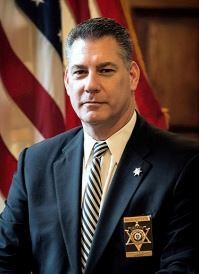
MEMBER SPOTLIGHT
Sheriff of Middlesex County, Massachusetts
Jails can be isolating and inhumane places that don’t help prepare people in meaningful ways for life on the outside. Recognizing that the consequences for older adults behind bars can be even more pronounced, a sheriff in Massachusetts set out to learn more about aging and incarceration – and tried something different.
As Middlesex County Sheriff Peter Koutoujian sees it, “Unique programming for unique individuals creates unique results.” Koutoujian isn’t interested in a cookie-cutter approach to the jail he oversees, the people held there, their families, or his staff.
His office has created programs tailored to the needs of incarcerated military veterans, young adults, and others. Those initiatives have shown reduced recidivism rates, and there has been measurable harm reduction among participants in medication assisted treatment (MAT) programming after their release. Building on these successes, the sheriff’s office now has another innovative effort underway. The Older Adult Re-Entry (OAR) unit at the Middlesex Jail & House of Correction, launched in October 2024, is designed explicitly to help prepare older adults behind bars for life back in the community.
Although some other facilities throughout the country have dedicated units for older people, OAR may be the first jail program developed with such an extensive focus on the physical, developmental, cognitive, social, and reentry concerns of this population. Research has long shown that aging is accelerated for people who are incarcerated. At the jail in Billerica, 45 miles north of Boston, OAR is changing the day-to-day for some of the men who are 55 and older – and potentially their future.
Koutoujian says the age of people on the inside reflects the “graying” of society beyond the walls of jails and prisons. Ten percent of the jail’s population is at least age 55, double what it was just a decade ago. By 2030, an anticipated one in four people incarcerated there will be 60 or older. (A recent report found that as of 2022, roughly one in six people in U.S. prisons nationwide were age 55 or older, and the human and fiscal costs are growing “exponentially.” Another showed that the proportion of people who were at least 55 in the country’s jails grew more than any age group during the COVID-19 pandemic.)
Paradoxically, it was the jail’s programming with young adults that spurred Koutoujian’s thinking about OAR. “It was remarkably successful because we had their specific needs in mind,” he recounted at LEL’s meeting in June last year. “But I realized that we were not thinking about how we’re preparing older adults for their specific needs, to be successful in their reentry. About 40 percent of them have done at least 4 to 10 stints in jail, which ages them more quickly – and shows that we’re not preparing them to stay out of jail, that we’re not preparing them for the rest of their lives.” He decided it was time to do something new.
And he wanted to do it right. To make sure the programming was driven by evidence and data, his office worked with the Gerontology Institute at the University of Massachusetts Boston. “We conducted research and surveys with officers and incarcerated individuals to see the need, the desire, and the interest in this unit,” he recalls. The UMass team concluded that a specialized program could benefit older adults in the jail. The sheriff’s department soon joined forces with the Department of Occupational Therapy at Boston University’s Sargent College of Health & Rehabilitation Sciences. As Koutoujian notes, it is “one of the most substantive academic/correctional partnerships in the country.”
“They’re involved in everything we do, guiding us on the color psychology, bed heights, seating arrangements – everything. It’s a lot of the small details, but some of the bigger details – and the programming is different too.” The dean of Sargent College observed in a recent article highlighting this collaboration that OAR, with its emphasis on occupational therapy, physical therapy, and specialized programming, has the potential to “pave the way for a more equitable and rehabilitative approach to corrections.”
In addition to the unit’s enhanced accessibility, including attention to vision and hearing issues common among older adults, OAR is based on five pillars: cognitive behavioral treatment; social enrichment; education; occupational therapy; and healthy living. Koutoujian said that the pillars, based on research, “aim to reduce isolation, foster prosocial behavior, and promote cognitive health.” He added that “challenging the mind is something we focus a little bit more on here than we do in other units, since this acts as a protective factor against cognitive decline.” He stresses that OAR focuses on quality-of-life issues in the here and now as well as fostering skills, habits, routines, and connections that can help people succeed when they reenter the community.
One man living in the unit last year, Roger Richardson, now 60, told a reporter that it’s “quieter, calmer, and more comfortable” than other parts of the medium-security jail. Like others in the program, he had been in and out of jail throughout his adult life – sometimes for drug offenses and other times simply for violating the conditions of his probation. Describing the program, he observed, “I took a lot out of it, you know, and I put a lot of work into it. . . . I have a good team here, a good team at home to help me out, so I feel confident.” Likewise, Officer Kevin Ouellette, who works in the unit, reinforced its positive impact in another news report, saying he has “noticed a difference” among participants and that “ ‘They’ll come up to you and say, “Hey, I really like this program.” ’ ”
For Koutoujian, improving the quality of his staff’s work life is also a major goal. In 2011, when he started his job – having worked previously as a public defender, an attorney in private practice, a prosecutor, and a state representative – the atmosphere was different. But as he stressed at LEL’s meeting, creating a culture open to change and improving staff well-being are mutually reinforcing priorities. “I needed not only the officers and staff to embrace the culture of innovation, but then to lead the culture change; to not just participate, but to drive it with their own ideas. And when you see your officers coming up with ideas in these specialty units . . . that means you’ve achieved something significant, powerful, important, and exciting.”
In an interview that aired in January on the podcast A Black Executive Perspective, the sheriff gave a vivid example of staff initiative. One officer realized that because older people may have diminished hearing or eyesight, some of their behavior could be misread as insolence. “The officers themselves came up with a chart . . . of all the people in the unit – and color-coded those who had hearing issues and sight issues and both,” so that staff working on the unit would be aware of those challenges.
“You can create a culture of well-being,” Koutoujian says, “not just for those who are incarcerated, but for your officers. It’s a very difficult job. But if you incorporate innovative units that they are buying into and taking pride in and they’re actually driving the ideas within those units . . . what we’ve achieved is a culture of innovation and the wellness that it achieves. They participate more with the incarcerated individuals, with staff – and . . . they give us some ideas. They go home and tell their loved ones a little bit about what they did that day, that they did something positive to make a difference in someone’s lives.” Indeed, the Major County Sheriffs of America recognized the innovative programming in Middlesex County and a “focus on employee wellness” when they named Koutoujian 2023 Sheriff of the Year. And in 2025, the Massachusetts Sheriff’s Association presented OAR its Innovation of the Year Award.
Regarding the men in custody at the jail, the sheriff is persistent. As he said in the January podcast, “People need that helping hand. You reach out that hand . . . it might be the 10th or the 15th time – you pull them up, pull them in, pull them on board. And it’s not just them, but their family members too.” He added, “We have a responsibility to those that are in our custody to prepare them for their reentry . . . reengaging with their family, getting a job, paying taxes, not committing other crimes. If I can do my job well, I can actually create a much safer community, and in those same efforts, a more humane community. That’s what I love.”

We aim to build a fairer and more effective criminal justice system by replacing ineffective policies with practical, tested practices that reduce both crime and unnecessary incarceration.

A project of the Brennan Center for Justice at NYU Law
© 2025 Law Enforcement LeadersPrivacy Policy Accessibility