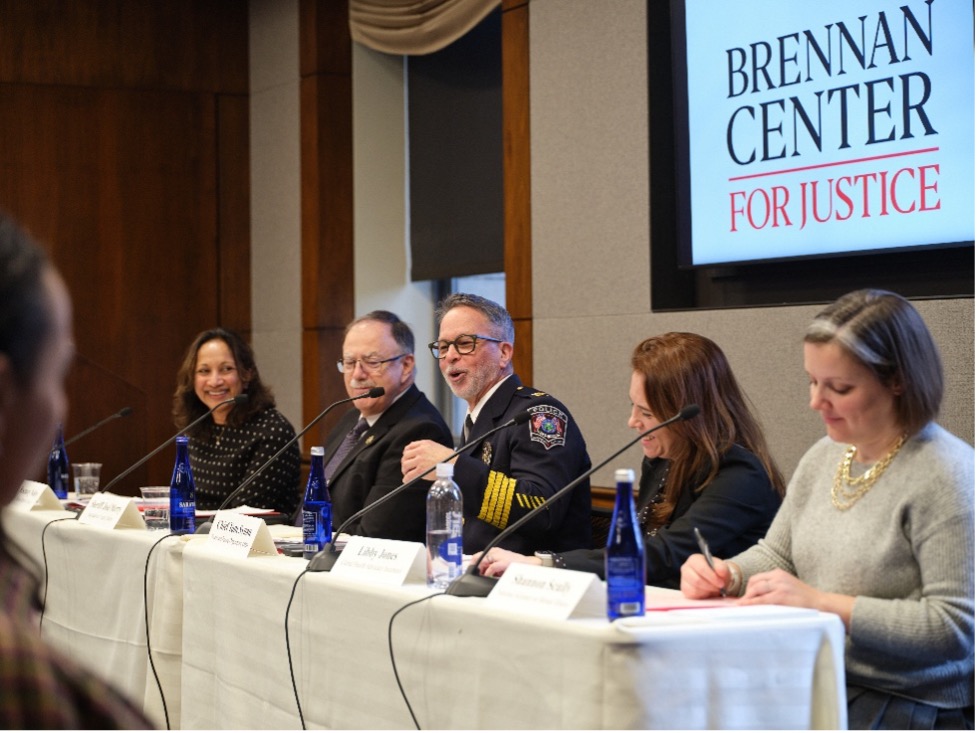
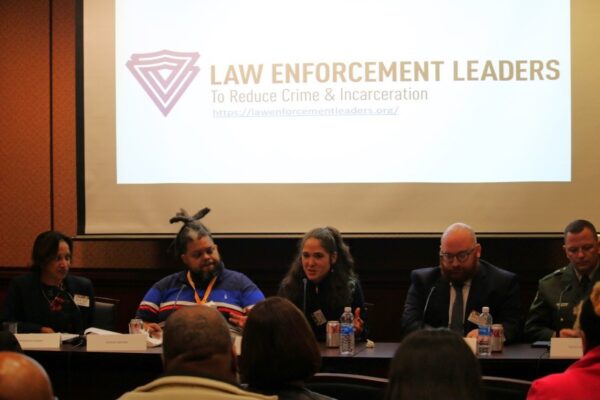
On January 14, 2026, the Brennan Center’s Justice Program hosted a bipartisan Congressional briefing on federal funding cuts to health and their impact on public safety. The event was sponsored by Representative Jamie Raskin (D-MD-8). Rep. Rutherford, a former sheriff who has championed reentry legislation in Congress, also delivered opening remarks on the importance of access to health care and substance treatment to reduce barriers people face upon release.
Rosemary Nidiry, LEL Director and Senior Counsel at the Brennan Center’s Justice Program, moderated the discussion, which brought together local law enforcement leaders, including LEL member Joel Merry, Sheriff of Sagadahoc County, Maine, and behavioral health experts who discussed the importance of federal investments in behavioral health for public safety and how early intervention and high-quality care can reduce justice system involvement.
Panel Highlights:
Sheriff Merry described how his office works with service providers, to ensure that reentry planning now begins on day one of incarceration. He also highlighted current challenges, such as connecting people to primary care and other health services in rural communities, that could increase with further health care cuts.
Tom Synan, Chief of Police in Newtown, Ohio, discussed the Hamilton County Addiction Response Coalition, a collaboration between law enforcement and community organizations that has achieved dramatic reductions in overdose deaths since 2017. He noted that recent federal funding cuts have already eliminated $2 million from the county’’s treatment court program.
Shannon Scully, Director of Justice Policy & Initiatives at the National Alliance on Mental Illness, noted that 2 million people are booked into jail each year due to symptoms of untreated mental illness rather than criminal behavior, and that rolling back federal community mental health investments will shift more of that burden onto law enforcement.
Libby Jones, Associate Vice President of the Overdose Prevention Initiative at the Global Health Advocacy Incubator, addressed how the approximately $2 billion in SAMHSA cuts announced that day would exacerbate substance addiction problems (the cuts were reversed later that day). She noted that people released from incarceration are 40 times more likely to die from an overdose in the weeks following release and screening, medication-assisted treatment, and linkage to care during incarceration are among the most effective tools for preventing those deaths.